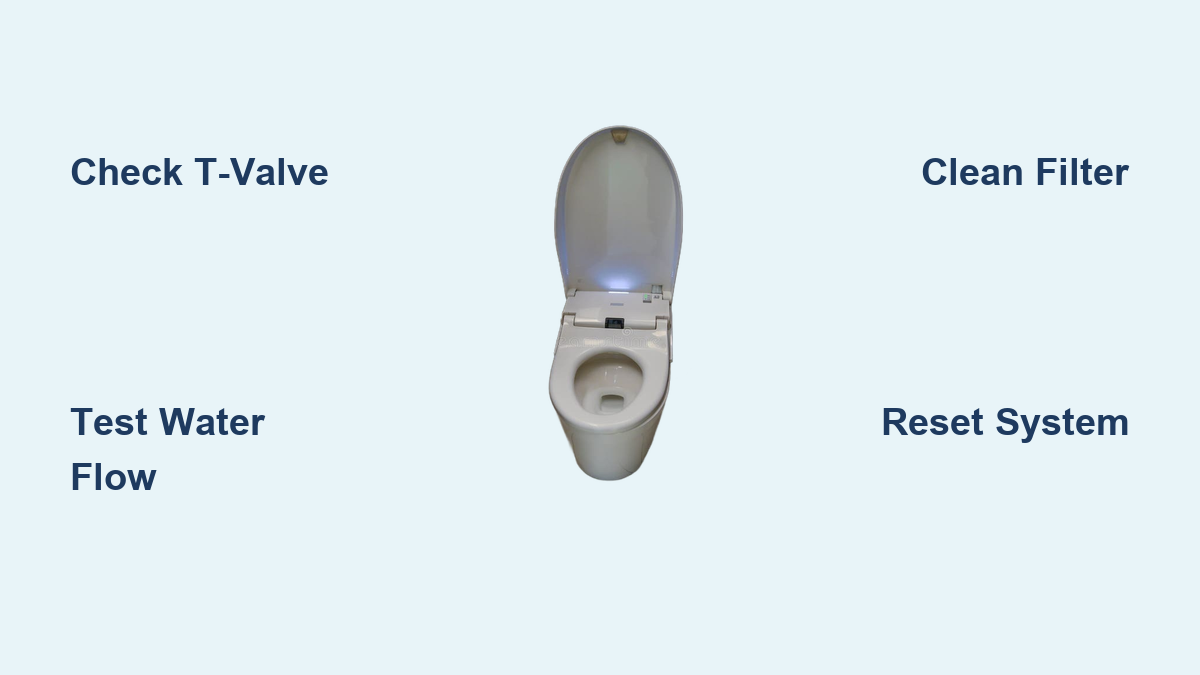
Your toilet flushes fine, but the bidet won’t spray. Just a drip or nothing at all. You’re not alone. Bidet toilet not working is one of the most common complaints after installation or over time. The frustration is real. You invested in comfort and hygiene, only to be left with a high-tech seat that won’t perform.
The core issue? Water reaches the toilet tank, but the bidet fails to deliver a proper spray. This isn’t usually a total water cutoff. It’s a blockage, sensor failure, or system incompatibility. The good news: most problems are fixable with simple checks. The bad news? Some bidets simply won’t work on low-pressure plumbing, especially in regions like the UK.
Check Water Supply Valves
Confirm T-Valve Is Fully Open
The T-fitting splits water between the toilet tank and bidet seat. If the bidet side valve is partially closed, it may allow enough flow to refill the tank but not power the spray.
Locate the T-valve behind the toilet. Ensure the bidet shutoff knob is turned fully counterclockwise. Even a slightly closed valve can starve the bidet of pressure.
- Some users unknowingly leave the valve half-closed during installation, thinking it prevents leaks. But this kills bidet performance.
Inspect Main Shut-Off Valve
Even if the T-valve is open, the main supply valve might be restricted. Turn the main valve fully open counterclockwise. Use a wrench if needed. Don’t assume hand-tight is enough. A stiff or corroded valve may not open completely without force.
If both valves are open but the bidet still drips, move to pressure testing.
Test Your Water Flow Rate
Verify Minimum 20 L/min Supply
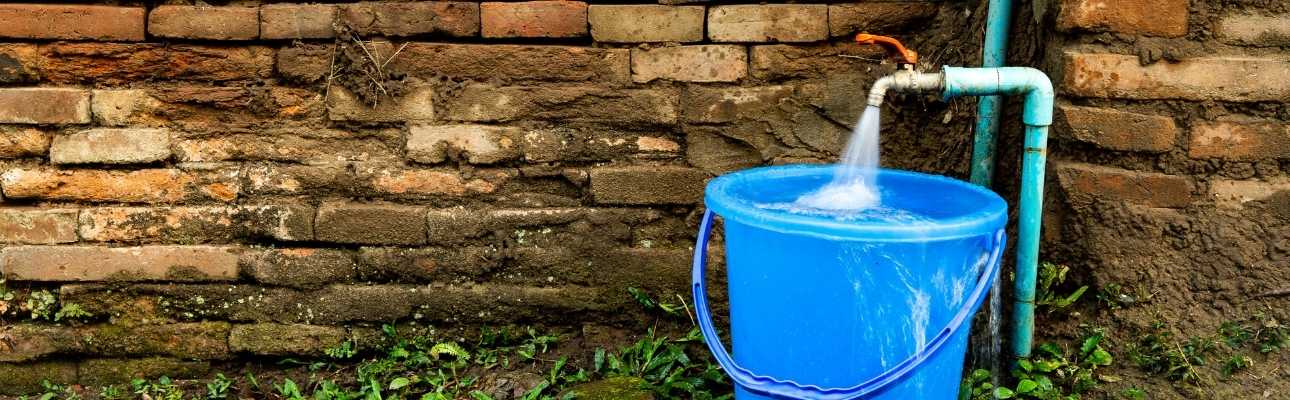
Bidet seats need 20 liters per minute to function. That’s 5 liters every 15 seconds. Place a bucket under the toilet supply line. Open the valve fully and time how much water flows in 15 seconds. Multiply by 4 to get L/min.
If your flow is below 20 L/min, the bidet likely won’t spray, no matter what you do.
- This isn’t about pressure (PSI). It’s about flow capacity. Many homes, especially in the UK, can’t meet this demand.
Know Your Home’s Limits
Ideal household pressure ranges from 40 to 60 psi. Maximum safe pressure is 80 psi. Bidets cannot boost weak supply. They rely entirely on your plumbing.
If other fixtures like the sink or shower have weak flow, the issue is whole-house low pressure. If only the bidet fails, the problem is localized.
Diagnose Sensor Activation Failure
Test Skin Contact Sensor
Most bidets use capacitive sensors to detect occupancy. If not triggered, no spray occurs. Find the sensor at the 4 to 5 o’clock position on the right side. Bio Bidet A8 models have it at 7 to 8 o’clock on the left side.
Place a damp 4×4 inch paper towel over the sensor zone. Listen for a brief self-cleaning flush. This confirms activation.
No flush? Try the weight or IR sensor test.
Check Weight-Activated Seat
TOTO and Kohler models use weight-activated sensors. Press down firmly near the left rear hinge. You should feel a mechanical click. Hold pressure while testing wash functions.
If no response, the sensor or control board may be faulty.
Trigger Infrared Sensor
Kohler Novita BH-90 and BH-93 models use rear IR sensors. Cover the dark panel at the back with a paper towel. This simulates body presence and should activate the system.
- If no self-clean flush happens, the issue could be sensor, power, or PCB. Not the nozzle.
Fix Remote Control Issues
Replace Remote Batteries
Weak batteries are the number one cause of bidet not responding. Use fresh alkaline batteries, not zinc-carbon. Remove old cells and clean battery contacts with a cotton swab. Test immediately after replacement.
- Many users assume the remote is broken when it’s just low on power.
Clear IR Signal Obstructions
Bidet remotes use infrared. They need line-of-sight. Ensure nothing blocks the path between remote and IR receiver. Avoid mounting the remote behind glass or plastic. Try holding the remote over your shoulder, pointing up. IR can bounce off walls.
Test Signal Range and Pairing
Most remotes work within 6 to 10 feet. If unresponsive, re-pair using the manufacturer’s sync method. Often this involves holding a button. Test from directly in front of the toilet to rule out angle issues.
Use Auxiliary Buttons to Isolate Fault
Bypass the Remote
Every smart bidet has physical buttons on the seat. Trigger the seat sensor with damp paper or by sitting down. Press the rear wash button on the side of the seat.
If spray works, the problem is the remote or signal. If no spray, there’s an internal failure involving the pump, valve, or nozzle.
- This test separates user error from hardware failure.
Confirm Function While Seated
Repeat the test while actually sitting. Weight sensors may not activate otherwise. If auxiliary buttons fail, move to mechanical checks.
Realign and Re-Mount the Bidet Seat
Check for Loose or Misaligned Seat
A seat not fully locked will disable functions. Pull the front gently. If it moves, it’s not seated. Look for contact between the back of the bidet and the tank.
Re-Lock the Seat Properly
Press the release button, usually under the front edge. Slide the seat forward off the bracket. Re-seat it with a firm push until it clicks.
If it hits the tank, loosen the mounting bolts. Shift the bracket slightly forward. Retighten.
Test After Re-Mounting
Retrigger the sensor and test spray. If it now works, misalignment was the culprit.
- If no improvement, contact the manufacturer for support.
Clean the Strainer Filter

Locate and Remove the Filter
Shut off the water supply. Disconnect the inlet hose from the bidet. Find the mesh strainer inside the connector or valve body.
Flush and Descale
Rinse under running water. Soak in white vinegar for 15 to 30 minutes if scaled. Reinstall and reconnect securely.
- Clean the filter every 3 to 6 months. More often in hard water areas.
Clogged filters are a top cause of weak or no spray.
Unclog the Nozzle
Try Self-Cleaning Mode First
Activate the bidet’s automatic nozzle clean. Listen for water flush at the nozzle tip. If no flow, proceed manually.
Manual Cleaning Steps
Mix equal parts water and white vinegar. Add a few drops of pH-neutral dish soap. Spray onto the nozzle. Gently scrub with a soft toothbrush. Rinse thoroughly.
- Never use abrasive tools. They damage seals and sensors.
For stubborn scale, soak the nozzle area in vinegar for 30 minutes.
Reset the Bidet System
Perform a Hard Reset
Like rebooting a computer, this clears electronic glitches. Unplug the bidet for 30 seconds to 5 minutes. Plug back in. Wait for startup lights and self-test. Retest spray.
- For stubborn issues, unplug for 3 to 5 minutes to fully discharge capacitors.
Many dead bidets come back to life after a reset.
Verify Power Supply and Outlet
Test the GFCI Outlet
Bidets require GFCI-protected power. Plug in a lamp or phone charger to test the outlet. If dead, reset the GFCI or check the circuit breaker.
Check for Internal Power Failure
If the outlet works but the bidet doesn’t, ensure the power cord is fully inserted. Try a different outlet. If still dead, the internal fuse or power board may be blown.
- Never open the unit. Contact support instead.
Inspect for Leaks and Seal Failures
Fix Leaking T-Valve
A common drip point is the T-valve connection. Shut off water. Disconnect the bidet hose. Check for the black rubber O-ring inside the female end. Replace if missing, cracked, or deformed.
- Always reseat the O-ring before reconnecting.
Diagnose Nozzle Leaks
Clean the nozzle first. If it still leaks, internal seals may be damaged. Contact the manufacturer. Nozzle assemblies are often non-user-replaceable.
Identify Internal Component Failures
Failed Water Pump or Solenoid
Watch for these signs. No spray despite clean filter and power. Buzzing or humming when activated. Intermittent flow.
- Pumps don’t wear out quickly. If failed, it may follow a power surge or clog.
Faulty Control PCB
If there’s no response to sensors, buttons, or remote, error codes appear, or reset doesn’t help, the control board may be defective.
- PCB issues require professional repair or replacement.
Decide: Repair or Replace?
Replace If
Consider replacement if the bidet is over 5 years old. Multiple components have failed. Repair cost exceeds 50% of a new unit price. It never worked well from the start, indicating incompatibility.
Repair If
Repair is viable if the unit is under warranty. Only one part failed, like the filter or O-ring. It previously performed well.
- Always turn off water and power before any work.
Prevent Future Issues
Follow Maintenance Schedule
Clean the nozzle monthly. Flush the strainer every 3 to 6 months. Replace the odor filter every 6 to 12 months. Inspect hoses annually.
In hard water areas, double the cleaning frequency.
Install Inline Water Filter
An inline water filter prevents scale and sediment from entering the bidet. It reduces clogs. Extends pump and nozzle life. Low cost, high payoff.
When to Contact Support
Stop troubleshooting and call the manufacturer if error codes persist after reset. No improvement after checking valves, filters, and sensors. The problem started after a power surge. The bidet never worked right from installation. Internal buzz occurs but no spray happens.
Have ready the model and serial number, purchase date, steps you’ve tried, and photos or video of the issue.
Frequently Asked Questions About Bidet Toilet Not Working
Why does my bidet only drip instead of spray?
A dripping bidet usually indicates low water flow or a clogged filter. Check that the T-valve is fully open. Clean the strainer filter. Verify your home delivers at least 20 liters per minute.
Can low water pressure prevent a bidet from working?
Yes. Bidets require adequate flow capacity, not just pressure. If your home has low water pressure or flow, the bidet won’t spray properly. This is especially common in UK homes with standard plumbing.
How do I know if my bidet sensor is working?
Most bidets have a self-cleaning cycle that runs when the sensor detects occupancy. Test by placing a damp paper towel on the sensor zone. Listen for a brief water release from the nozzle.
Why is my bidet remote not responding?
Replace the batteries first. Use fresh alkaline cells. Check for obstructions between the remote and the IR receiver. Re-pair the remote if needed.
Should I try to repair my bidet myself?
Simple fixes like cleaning the filter, replacing batteries, or resetting the unit are safe to try. However, internal component failures like pump or PCB issues require professional service. Contact support if basic troubleshooting fails.
How long do bidet toilets typically last?
With regular maintenance, most bidets last 5 to 7 years. Lifespan depends on water quality, usage frequency, and how well the unit is maintained.
Key Takeaways for Fixing Your Bidet Toilet
Bidet toilet not working issues are usually fixable, but you must diagnose systematically. Start simple by checking valves and water flow. Then move to sensors, remotes, and filters. If all else fails, it may be a hardware flaw or plumbing incompatibility.
The most common causes are partially closed T-valves, clogged filters, weak home water pressure, and sensor activation issues. UK homeowners should verify flow rates before purchasing, as standard UK plumbing often can’t meet bidet requirements.
Regular maintenance extends your bidet’s life significantly. Clean the nozzle monthly. Flush filters every 3 to 6 months. Replace odor filters annually. Treat your bidet like the smart appliance it is, and it will keep you clean and comfortable for years.